Universal psychometrics encompasses psychometrics instruments that could measure the psychological properties of any intelligent agent. Up until the early 21st century, psychometrics relied heavily on psychological tests that require the subject to cooperate and answer questions, the most famous example being an intelligence test. Such methods are only applicable to the measurement of human psychological properties. As a result, some researchers have proposed the idea of universal psychometrics - they suggest developing testing methods that allow for the measurement of non-human entities' psychological properties. For example, it has been suggested that the Turing test is a form of universal psychometrics. This test involves having testers (without any foreknowledge) attempt to distinguish a human from a machine by interacting with both (while not being to see either individuals). It is supposed that if the machine is equally intelligent to a human, the testers will not be able to distinguish between the two, i.e., their guesses will not be better than chance. Thus, Turing test could measure the intelligence (a psychological variable) of an AI. Other instruments proposed for universal psychometrics include reinforcement learning and measuring the ability to predict complexity.
Cognitive robotics
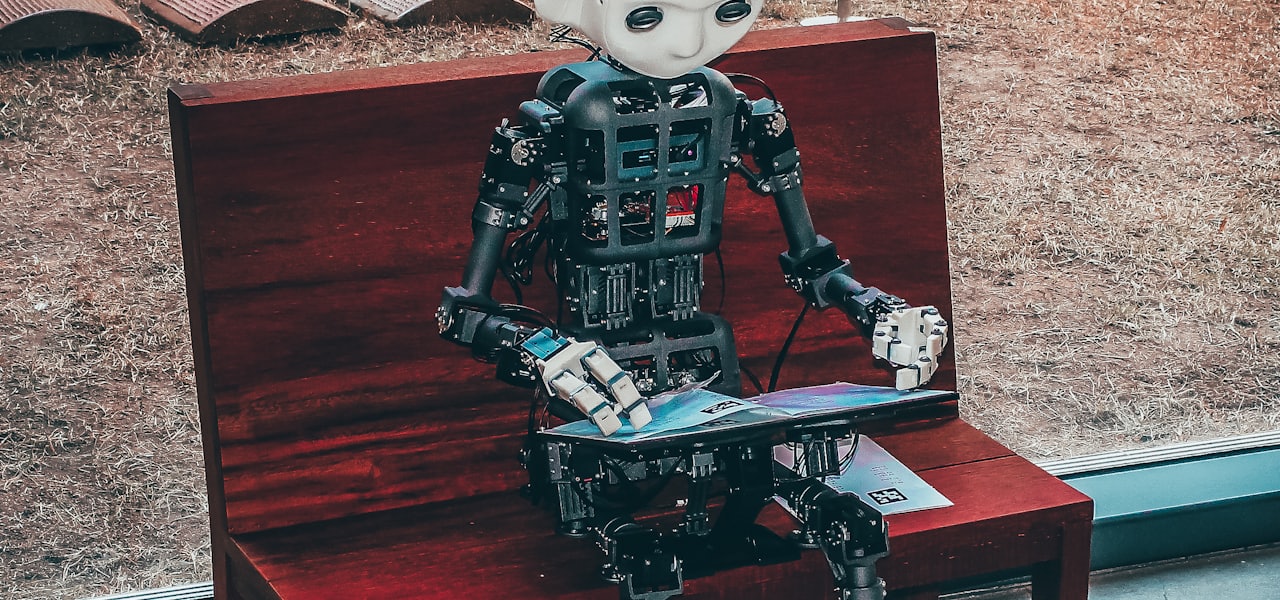
Cognitive robotics or cognitive technology is a subfield of robotics concerned with endowing a robot with intelligent behavior by providing it with a processing architecture that will allow it to learn and reason about how to behave in response to complex goals in a complex world. Cognitive robotics may be considered the engineering branch of embodied cognitive science and embodied embedded cognition, consisting of robotic process automation, artificial intelligence, machine learning, deep learning, optical character recognition, image processing, process mining, analytics, software development and system integration. == Core issues == While traditional cognitive modeling approaches have assumed symbolic coding schemes as a means for depicting the world, translating the world into these kinds of symbolic representations has proven to be problematic if not untenable. Perception and action and the notion of symbolic representation are therefore core issues to be addressed in cognitive robotics. == Starting point == Cognitive robotics views human or animal cognition as a starting point for the development of robotic information processing, as opposed to more traditional artificial intelligence techniques. Target robotic cognitive capabilities include perception processing, attention allocation, anticipation, planning, complex motor coordination, reasoning about other agents and perhaps even about their own mental states. Robotic cognition embodies the behavior of intelligent agents in the physical world (or a virtual world, in the case of simulated cognitive robotics). Ultimately, the robot must be able to act in the real world. == Learning techniques == === Motor Babble === A preliminary robot learning technique called motor babbling involves correlating pseudo-random complex motor movements by the robot with resulting visual and/or auditory feedback such that the robot may begin to expect a pattern of sensory feedback given a pattern of motor output. Desired sensory feedback may then be used to inform a motor control signal. This is thought to be analogous to how a baby learns to reach for objects or learns to produce speech sounds. For simpler robot systems, where, for instance, inverse kinematics may feasibly be used to transform anticipated feedback (desired motor result) into motor output, this step may be skipped. === Imitation === Once a robot can coordinate its motors to produce a desired result, the technique of learning by imitation may be used. The robot monitors the performance of another agent and then the robot tries to imitate that agent. It is often a challenge to transform imitation information from a complex scene into a desired motor result for the robot. Note that imitation is a high-level form of cognitive behavior and imitation is not necessarily required in a basic model of embodied animal cognition. === Knowledge acquisition === A more complex learning approach is "autonomous knowledge acquisition": the robot is left to explore the environment on its own. A system of goals and beliefs is typically assumed. A somewhat more directed mode of exploration can be achieved by "curiosity" algorithms, such as Intelligent Adaptive Curiosity or Category-Based Intrinsic Motivation. These algorithms generally involve breaking sensory input into a finite number of categories and assigning some sort of prediction system (such as an artificial neural network) to each. The prediction system keeps track of the error in its predictions over time. Reduction in prediction error is considered learning. The robot then preferentially explores categories in which it is learning (or reducing prediction error) the fastest. == Other architectures == Some researchers in cognitive robotics have tried using architectures such as (ACT-R and Soar (cognitive architecture)) as a basis of their cognitive robotics programs. These highly modular symbol-processing architectures have been used to simulate operator performance and human performance when modeling simplistic and symbolized laboratory data. The idea is to extend these architectures to handle real-world sensory input as that input continuously unfolds through time. What is needed is a way to somehow translate the world into a set of symbols and their relationships. == Questions == Some of the fundamental questions to be answered in cognitive robotics are: How much human programming should or can be involved to support the learning processes? How can one quantify progress? Some of the adopted ways are reward and punishment. But what kind of reward and what kind of punishment? In humans, when teaching a child, for example, the reward would be candy or some encouragement, and the punishment can take many forms. But what is an effective way with robots?
Semantic heterogeneity
Semantic heterogeneity is when database schema or datasets for the same domain are developed by independent parties, resulting in differences in meaning and interpretation of data values. Beyond structured data, the problem of semantic heterogeneity is compounded due to the flexibility of semi-structured data and various tagging methods applied to documents or unstructured data. Semantic heterogeneity is one of the more important sources of differences in heterogeneous datasets. Yet, for multiple data sources to interoperate with one another, it is essential to reconcile these semantic differences. Decomposing the various sources of semantic heterogeneities provides a basis for understanding how to map and transform data to overcome these differences. == Classification == One of the first known classification schemes applied to data semantics is from William Kent in the late 80s. Kent's approach dealt more with structural mapping issues than differences in meaning, which he pointed to data dictionaries as potentially solving. One of the most comprehensive classifications is from Pluempitiwiriyawej and Hammer, "Classification Scheme for Semantic and Schematic Heterogeneities in XML Data Sources". They classify heterogeneities into three broad classes: Structural conflicts arise when the schema of the sources representing related or overlapping data exhibit discrepancies. Structural conflicts can be detected when comparing the underlying schema. The class of structural conflicts includes generalization conflicts, aggregation conflicts, internal path discrepancy, missing items, element ordering, constraint and type mismatch, and naming conflicts between the element types and attribute names. Domain conflicts arise when the semantics of the data sources that will be integrated exhibit discrepancies. Domain conflicts can be detected by looking at the information contained in the schema and using knowledge about the underlying data domains. The class of domain conflicts includes schematic discrepancy, scale or unit, precision, and data representation conflicts. Data conflicts refer to discrepancies among similar or related data values across multiple sources. Data conflicts can only be detected by comparing the underlying sources. The class of data conflicts includes ID-value, missing data, incorrect spelling, and naming conflicts between the element contents and the attribute values. Moreover, mismatches or conflicts can occur between set elements (a "population" mismatch) or attributes (a "description" mismatch). Michael Bergman expanded upon this schema by adding a fourth major explicit category of language, and also added some examples of each kind of semantic heterogeneity, resulting in about 40 distinct potential categories . This table shows the combined 40 possible sources of semantic heterogeneities across sources: A different approach toward classifying semantics and integration approaches is taken by Sheth et al. Under their concept, they split semantics into three forms: implicit, formal and powerful. Implicit semantics are what is either largely present or can easily be extracted; formal languages, though relatively scarce, occur in the form of ontologies or other description logics; and powerful (soft) semantics are fuzzy and not limited to rigid set-based assignments. Sheth et al.'s main point is that first-order logic (FOL) or description logic is inadequate alone to properly capture the needed semantics. == Relevant applications == Besides data interoperability, relevant areas in information technology that depend on reconciling semantic heterogeneities include data mapping, semantic integration, and enterprise information integration, among many others. From the conceptual to actual data, there are differences in perspective, vocabularies, measures and conventions once any two data sources are brought together. Explicit attention to these semantic heterogeneities is one means to get the information to integrate or interoperate. A mere twenty years ago, information technology systems expressed and stored data in a multitude of formats and systems. The Internet and Web protocols have done much to overcome these sources of differences. While there is a large number of categories of semantic heterogeneity, these categories are also patterned and can be anticipated and corrected. These patterned sources inform what kind of work must be done to overcome semantic differences where they still reside.
Query rewriting
Query rewriting is a typically automatic transformation that takes a set of database tables, views, and/or queries, usually indices, often gathered data and query statistics, and other metadata, and yields a set of different queries, which produce the same results but execute with better performance (for example, faster, or with lower memory use). Query rewriting can be based on relational algebra or an extension thereof (e.g. multiset relational algebra with sorting, aggregation and three-valued predicates i.e. NULLs as in the case of SQL). The equivalence rules of relational algebra are exploited, in other words, different query structures and orderings can be mathematically proven to yield the same result. For example, filtering on fields A and B, or cross joining R and S can be done in any order, but there can be a performance difference. Multiple operations may be combined, and operation orders may be altered. The result of query rewriting may not be at the same abstraction level or application programming interface (API) as the original set of queries (though often is). For example, the input queries may be in relational algebra or SQL, and the rewritten queries may be closer to the physical representation of the data, e.g. array operations. Query rewriting can also involve materialization of views and other subqueries; operations that may or may not be available to the API user. The query rewriting transformation can be aided by creating indices from which the optimizer can choose (some database systems create their own indexes if deemed useful), mandating the use of specific indices, creating materialized and/or denormalized views, or helping a database system gather statistics on the data and query use, as the optimality depends on patterns in data and typical query usage. Query rewriting may be rule based or optimizer based. Some sources discuss query rewriting as a distinct step prior to optimization, operating at the level of the user accessible algebra API (e.g. SQL). There are other, largely unrelated concepts also named similarly, for example, query rewriting by search engines.
Knowledge organization
Knowledge organization (KO), organization of knowledge, organization of information, or information organization is an intellectual discipline concerned with activities such as document description, indexing, and classification that serve to provide systems of representation and order for knowledge and information objects. According to The Organization of Information by Joudrey and Taylor, information organization: examines the activities carried out and tools used by people who work in places that accumulate information resources (e.g., books, maps, documents, datasets, images) for the use of humankind, both immediately and for posterity. It discusses the processes that are in place to make resources findable, whether someone is searching for a single known item or is browsing through hundreds of resources just hoping to discover something useful. Information organization supports a myriad of information-seeking scenarios. Issues related to knowledge sharing can be said to have been an important part of knowledge management for a long time. Knowledge sharing has received a lot of attention in research and business practice both within and outside organizations and its different levels. Sharing knowledge is not only about giving it to others, but it also includes searching, locating, and absorbing knowledge. Unawareness of the employees' work and duties tends to provoke the repetition of mistakes, the waste of resources, and duplication of the same projects. Motivating co-workers to share their knowledge is called knowledge enabling. It leads to trust among individuals and encourages a more open and proactive relationship that grants the exchange of information easily. Knowledge sharing is part of the three-phase knowledge management process which is a continuous process model. The three parts are knowledge creation, knowledge implementation, and knowledge sharing. The process is continuous, which is why the parts cannot be fully separated. Knowledge creation is the consequence of individuals' minds, interactions, and activities. Developing new ideas and arrangements alludes to the process of knowledge creation. Using the knowledge which is present at the company in the most effective manner stands for the implementation of knowledge. Knowledge sharing, the most essential part of the process for our topic, takes place when two or more people benefit by learning from each other. Traditional human-based approaches performed by librarians, archivists, and subject specialists are increasingly challenged by computational (big data) algorithmic techniques. KO as a field of study is concerned with the nature and quality of such knowledge-organizing processes (KOP) (such as taxonomy and ontology) as well as the resulting knowledge organizing systems (KOS). == Theoretical approaches == === Traditional approaches === Among the major figures in the history of KO are Melvil Dewey (1851–1931) and Henry Bliss (1870–1955). Dewey's goal was an efficient way to manage library collections; not an optimal system to support users of libraries. His system was meant to be used in many libraries as a standardized way to manage collections. The first version of this system was created in 1876. An important characteristic in Henry Bliss' (and many contemporary thinkers of KO) was that the sciences tend to reflect the order of Nature and that library classification should reflect the order of knowledge as uncovered by science: The implication is that librarians, in order to classify books, should know about scientific developments. This should also be reflected in their education: Again from the standpoint of the higher education of librarians, the teaching of systems of classification ... would be perhaps better conducted by including courses in the systematic encyclopedia and methodology of all the sciences, that is to say, outlines which try to summarize the most recent results in the relation to one another in which they are now studied together. ... (Ernest Cushing Richardson, quoted from Bliss, 1935, p. 2) Among the other principles, which may be attributed to the traditional approach to KO are: Principle of controlled vocabulary Cutter's rule about specificity Hulme's principle of literary warrant (1911) Principle of organizing from the general to the specific Today, after more than 100 years of research and development in LIS, the "traditional" approach still has a strong position in KO and in many ways its principles still dominate. === Facet analytic approaches === The date of the foundation of this approach may be chosen as the publication of S. R. Ranganathan's colon classification in 1933. The approach has been further developed by, in particular, the British Classification Research Group. The best way to explain this approach is probably to explain its analytico-synthetic methodology. The meaning of the term "analysis" is: breaking down each subject into its basic concepts. The meaning of the term synthesis is: combining the relevant units and concepts to describe the subject matter of the information package in hand. Given subjects (as they appear in, for example, book titles) are first analyzed into a few common categories, which are termed "facets". Ranganathan proposed his PMEST formula: Personality, Matter, Energy, Space and Time: Personality is the distinguishing characteristic of a subject. Matter is the physical material of which a subject may be composed. Energy is any action that occurs with respect to the subject. Space is the geographic component of the location of a subject. Time is the period associated with a subject. === The information retrieval tradition (IR) === Important in the IR-tradition have been, among others, the Cranfield experiments, which were founded in the 1950s, and the TREC experiments (Text Retrieval Conferences) starting in 1992. It was the Cranfield experiments, which introduced the measures "recall" and "precision" as evaluation criteria for systems efficiency. The Cranfield experiments found that classification systems like UDC and facet-analytic systems were less efficient compared to free-text searches or low level indexing systems ("UNITERM"). The Cranfield I test found, according to Ellis (1996, 3–6) the following results: Although these results have been criticized and questioned, the IR-tradition became much more influential while library classification research lost influence. The dominant trend has been to regard only statistical averages. What has largely been neglected is to ask: Are there certain kinds of questions in relation to which other kinds of representation, for example, controlled vocabularies, may improve recall and precision? === User-oriented and cognitive views === The best way to define this approach is probably by method: Systems based upon user-oriented approaches must specify how the design of a system is made on the basis of empirical studies of users. User studies demonstrated very early that users prefer verbal search systems as opposed to systems based on classification notations. This is one example of a principle derived from empirical studies of users. Adherents of classification notations may, of course, still have an argument: That notations are well-defined and that users may miss important information by not considering them. Folksonomies is a recent kind of KO based on users' rather than on librarians' or subject specialists' indexing. === Bibliometric approaches === These approaches are primarily based on using bibliographical references to organize networks of papers, mainly by bibliographic coupling (introduced by Kessler 1963) or co-citation analysis ( independently suggested by Marshakova 1973 and Small 1973). In recent years it has become a popular activity to construe bibliometric maps as structures of research fields. Two considerations are important in considering bibliometric approaches to KO: The level of indexing depth is partly determined by the number of terms assigned to each document. In citation indexing this corresponds to the number of references in a given paper. On the average, scientific papers contain 10–15 references, which provide quite a high level of depth. The references, which function as access points, are provided by the highest subject-expertise: The experts writing in the leading journals. This expertise is much higher than that which library catalogs or bibliographical databases typically are able to draw on. === The domain analytic approach === Domain analysis is a sociological-epistemological standpoint that advocates that the indexing of a given document should reflect the needs of a given group of users or a given ideal purpose. In other words, any description or representation of a given document is more or less suited to the fulfillment of certain tasks. A description is never objective or neutral, and the goal is not to standardize descriptions or make one description once and for all for different target groups. The develo
Cross-entropy method
The cross-entropy (CE) method is a Monte Carlo method for importance sampling and optimization. It is applicable to both combinatorial and continuous problems, with either a static or noisy objective. The method approximates the optimal importance sampling estimator by repeating two phases: Draw a sample from a probability distribution. Minimize the cross-entropy between this distribution and a target distribution to produce a better sample in the next iteration. Reuven Rubinstein developed the method in the context of rare-event simulation, where tiny probabilities must be estimated, for example in network reliability analysis, queueing models, or performance analysis of telecommunication systems. The method has also been applied to the traveling salesman, quadratic assignment, DNA sequence alignment, max-cut and buffer allocation problems. == Estimation via importance sampling == Consider the general problem of estimating the quantity ℓ = E u [ H ( X ) ] = ∫ H ( x ) f ( x ; u ) d x {\displaystyle \ell =\mathbb {E} _{\mathbf {u} }[H(\mathbf {X} )]=\int H(\mathbf {x} )\,f(\mathbf {x} ;\mathbf {u} )\,{\textrm {d}}\mathbf {x} } , where H {\displaystyle H} is some performance function and f ( x ; u ) {\displaystyle f(\mathbf {x} ;\mathbf {u} )} is a member of some parametric family of distributions. Using importance sampling this quantity can be estimated as ℓ ^ = 1 N ∑ i = 1 N H ( X i ) f ( X i ; u ) g ( X i ) {\displaystyle {\hat {\ell }}={\frac {1}{N}}\sum _{i=1}^{N}H(\mathbf {X} _{i}){\frac {f(\mathbf {X} _{i};\mathbf {u} )}{g(\mathbf {X} _{i})}}} , where X 1 , … , X N {\displaystyle \mathbf {X} _{1},\dots ,\mathbf {X} _{N}} is a random sample from g {\displaystyle g\,} . For positive H {\displaystyle H} , the theoretically optimal importance sampling density (PDF) is given by g ∗ ( x ) = H ( x ) f ( x ; u ) / ℓ {\displaystyle g^{}(\mathbf {x} )=H(\mathbf {x} )f(\mathbf {x} ;\mathbf {u} )/\ell } . This, however, depends on the unknown ℓ {\displaystyle \ell } . The CE method aims to approximate the optimal PDF by adaptively selecting members of the parametric family that are closest (in the Kullback–Leibler sense) to the optimal PDF g ∗ {\displaystyle g^{}} . == Generic CE algorithm == Choose initial parameter vector v ( 0 ) {\displaystyle \mathbf {v} ^{(0)}} ; set t = 1. Generate a random sample X 1 , … , X N {\displaystyle \mathbf {X} _{1},\dots ,\mathbf {X} _{N}} from f ( ⋅ ; v ( t − 1 ) ) {\displaystyle f(\cdot ;\mathbf {v} ^{(t-1)})} Solve for v ( t ) {\displaystyle \mathbf {v} ^{(t)}} , where v ( t ) = argmax v 1 N ∑ i = 1 N H ( X i ) f ( X i ; u ) f ( X i ; v ( t − 1 ) ) log f ( X i ; v ) {\displaystyle \mathbf {v} ^{(t)}=\mathop {\textrm {argmax}} _{\mathbf {v} }{\frac {1}{N}}\sum _{i=1}^{N}H(\mathbf {X} _{i}){\frac {f(\mathbf {X} _{i};\mathbf {u} )}{f(\mathbf {X} _{i};\mathbf {v} ^{(t-1)})}}\log f(\mathbf {X} _{i};\mathbf {v} )} If convergence is reached then stop; otherwise, increase t by 1 and reiterate from step 2. In several cases, the solution to step 3 can be found analytically. Situations in which this occurs are When f {\displaystyle f\,} belongs to the natural exponential family When f {\displaystyle f\,} is discrete with finite support When H ( X ) = I { x ∈ A } {\displaystyle H(\mathbf {X} )=\mathrm {I} _{\{\mathbf {x} \in A\}}} and f ( X i ; u ) = f ( X i ; v ( t − 1 ) ) {\displaystyle f(\mathbf {X} _{i};\mathbf {u} )=f(\mathbf {X} _{i};\mathbf {v} ^{(t-1)})} , then v ( t ) {\displaystyle \mathbf {v} ^{(t)}} corresponds to the maximum likelihood estimator based on those X k ∈ A {\displaystyle \mathbf {X} _{k}\in A} . == Continuous optimization—example == The same CE algorithm can be used for optimization, rather than estimation. Suppose the problem is to maximize some function S {\displaystyle S} , for example, S ( x ) = e − ( x − 2 ) 2 + 0.8 e − ( x + 2 ) 2 {\displaystyle S(x)={\textrm {e}}^{-(x-2)^{2}}+0.8\,{\textrm {e}}^{-(x+2)^{2}}} . To apply CE, one considers first the associated stochastic problem of estimating P θ ( S ( X ) ≥ γ ) {\displaystyle \mathbb {P} _{\boldsymbol {\theta }}(S(X)\geq \gamma )} for a given level γ {\displaystyle \gamma \,} , and parametric family { f ( ⋅ ; θ ) } {\displaystyle \left\{f(\cdot ;{\boldsymbol {\theta }})\right\}} , for example the 1-dimensional Gaussian distribution, parameterized by its mean μ t {\displaystyle \mu _{t}\,} and variance σ t 2 {\displaystyle \sigma _{t}^{2}} (so θ = ( μ , σ 2 ) {\displaystyle {\boldsymbol {\theta }}=(\mu ,\sigma ^{2})} here). Hence, for a given γ {\displaystyle \gamma \,} , the goal is to find θ {\displaystyle {\boldsymbol {\theta }}} so that D K L ( I { S ( x ) ≥ γ } ‖ f θ ) {\displaystyle D_{\mathrm {KL} }({\textrm {I}}_{\{S(x)\geq \gamma \}}\|f_{\boldsymbol {\theta }})} is minimized. This is done by solving the sample version (stochastic counterpart) of the KL divergence minimization problem, as in step 3 above. It turns out that parameters that minimize the stochastic counterpart for this choice of target distribution and parametric family are the sample mean and sample variance corresponding to the elite samples, which are those samples that have objective function value ≥ γ {\displaystyle \geq \gamma } . The worst of the elite samples is then used as the level parameter for the next iteration. This yields the following randomized algorithm that happens to coincide with the so-called Estimation of Multivariate Normal Algorithm (EMNA), an estimation of distribution algorithm. === Pseudocode === // Initialize parameters μ := −6 σ2 := 100 t := 0 maxits := 100 N := 100 Ne := 10 // While maxits not exceeded and not converged while t < maxits and σ2 > ε do // Obtain N samples from current sampling distribution X := SampleGaussian(μ, σ2, N) // Evaluate objective function at sampled points S := exp(−(X − 2) ^ 2) + 0.8 exp(−(X + 2) ^ 2) // Sort X by objective function values in descending order X := sort(X, S) // Update parameters of sampling distribution via elite samples μ := mean(X(1:Ne)) σ2 := var(X(1:Ne)) t := t + 1 // Return mean of final sampling distribution as solution return μ == Related methods == Simulated annealing Genetic algorithms Harmony search Estimation of distribution algorithm Tabu search Natural Evolution Strategy Ant colony optimization algorithms
Operational historian
In manufacturing, an operational historian is a time-series database application that is developed for operational process data. Historian software is often embedded or used in conjunction with standard DCS and PLC control systems to provide enhanced data capture, validation, compression, and aggregation capabilities. Historians have been deployed in almost every industry and contribute to functions such as supervisory control, performance monitoring, quality assurance, and, more recently, machine learning applications which can learn from vast quantities of historical data. These systems were originally developed to capture instrumentation and control data, which led many to use the term "tag" for a stream of process data, referring to the physical "tags" which had been placed on instrumentation for manually capturing data. Raw data may be accessed via OPC HDA, SQL, or REST API interfaces. == Operational Support == Operational historians are typically used within the manufacturing facility by engineers and operators for supervisory functions and analysis. An operational historian will typically capture all instrumentation and control data, whereas an enterprise historian that is deployed to support business functions will capture only a subset of the plant data. Typically, these applications offer data access through dedicated APIs (Application Programming Interfaces) and SDKs (Software Development Kits) which offer high-performance read and write operations. These operate through vendor-specific or custom applications. Front-end tools for trending process data over time are the most common interfaces to these databases. Because these applications are typically deployed next to or near the source of their process data, they are often marketed and sold as 'real-time database systems.' This distinction varies among vendors, who often have to make tradeoffs in performance between data capture and presentation, and application and analysis functionality. The following is a list of typical challenges for operational historians: data collection from instrumentation and controls storage and archiving of very large volumes of data organization of data in the form of "tags" or "points" limiting of monitoring (alarms) and validation aggregation and interpolation manual data entry (MDE) == Data access == As opposed to enterprise historians, the data access layer in the operational historian is designed to offer sophisticated data fetching modes without complex information analysis facilities. The following settings are typically available for data access operations: Data scope (single point or tag, history based on time range, history based on sample count) Request modes (raw data, last-known value, aggregation, interpolation) Sampling (single point, all points without sampling, all points with interval sampling) Data omission (based on the sample quality, based on the sample value, based on the count) Even though the operational historians are rarely relational database management systems, they often offer SQL-based interfaces to query the database. In most of such implementations, the dialect does not follow the SQL standard in order to provide syntax for specifying data access operations parameters.